


“Sticker” and “label” get used interchangeably all the time — and honestly, it’s easy to see why. Both are printed, both are adhesive, both end up stuck to something. But if you’ve ever tried to order one and found yourself second-guessing which product page you actually need, you already know the distinction matters more than it seems.
At Pixartprinting, it’s one of the questions we hear most often from people ordering for the first time. Here’s the short answer: the difference isn’t really about the material — it’s about the job the piece is meant to do. A label identifies and informs. A sticker promotes and decorates. Everything else — format, cut, durability — follows from that one distinction.
Let’s break it down properly.
Stickers vs. Labels at a Glance
| Sticker | Label | |
|---|---|---|
| Main job | Promote, decorate, express | Identify, inform, comply |
| Typical cut | Die-cut (individual piece) | Kiss-cut (continuous roll) |
| Format | Sold as separate pieces | Peeled one at a time from a roll |
| Where it’s applied | By the recipient, anywhere they like | By the seller, to a specific product |
| Common examples | Laptop stickers, giveaways, bumper stickers | Wine bottle labels, shipping labels, ingredient lists |
| Typical order size | From 25 pieces | From 100 pieces |
This table is a starting point, not a rulebook — plenty of real-world products blur the line. Let’s look at why.
What Is a Sticker?
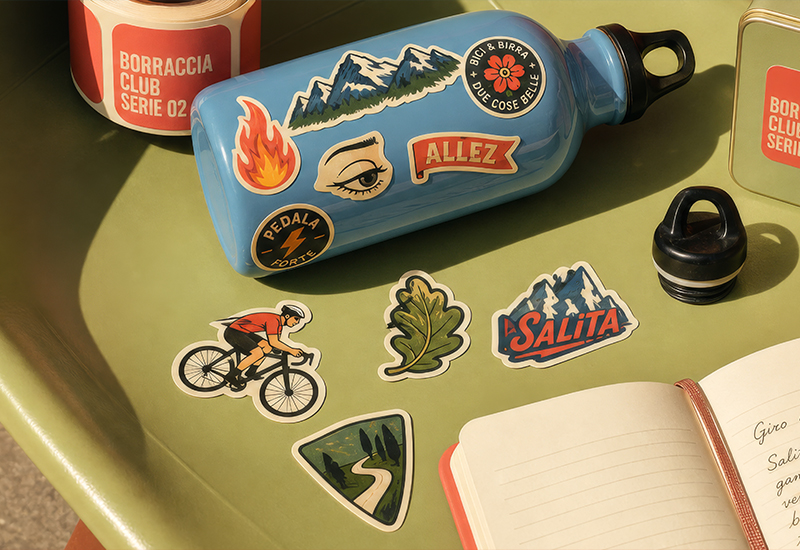
A sticker is a standalone adhesive piece where the design is the product. Nobody needs a sticker to function — you choose one because you like it, and then you decide where it goes: a laptop, a water bottle, a skateboard, a car bumper.
That freedom is the whole point. Stickers are built to travel with whoever owns them, which is why they show up so often as:
- giveaways at events and trade shows
- packaging inserts that double as a little bonus
- branding for merch, bands and small businesses
- purely decorative pieces, with no informational job at all
Because a sticker is meant to be handled, peeled and applied by someone other than the person who printed it, it’s usually produced as an individual, self-contained piece — which is exactly what a die-cut sticker is built for.
What Is a Label?
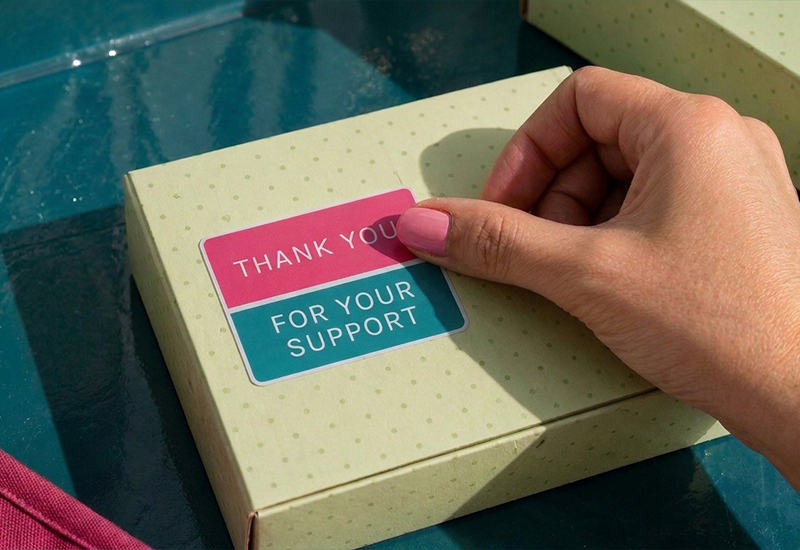
A label, on the other hand, has a job to do before anyone even notices the design. It identifies a product, explains what’s inside it, or gets it where it needs to go.
Think about what a label is actually expected to communicate:
- ingredients, allergens and nutritional information on food and drink
- batch numbers and usage instructions on cosmetics
- shipping and barcode information on packages
- brand name, price and product details on retail packaging
Because labels are applied by the seller — not the end customer — to a specific, known surface (a bottle, a jar, a box), they’re produced differently too. They’re printed in sequence on a continuous roll, ready to be applied quickly and consistently, one after another. At Pixartprinting, that’s the roll labels product line.
Kiss-Cut vs. Die-Cut: The Technical Difference That Actually Matters
Here’s where a lot of online explanations get vague — or get it wrong. The clearest, most reliable way to tell a sticker and a label apart isn’t the material or the picture on it. It’s how the piece is cut.
Kiss-cut means the blade cuts through the adhesive layer and the printed material, but stops before cutting through the backing liner. The result stays attached to a continuous strip, peeled off one at a time as it’s needed — by hand, or automatically through a labeling machine. This is what makes kiss-cut the standard for products that need to be labeled repeatedly and consistently: food and beverage, cosmetics, logistics, manufacturing.
Die-cut, by contrast, is a full cut straight through everything, backing included. What comes out is a single, separate piece with no strip attached — a finished object on its own. That’s exactly why die-cut is the standard for stickers: each one is meant to be picked up, handed out or applied individually, not peeled off a production line.
At Pixartprinting, this distinction lines up directly with the two product families: Roll Labels are kiss-cut, while Custom Stickers are die-cut. If you’re not sure which one you need, the cut type is usually the fastest way to figure it out — more reliable than trying to judge from the design alone.
How to Decide Which One You Need
If you’re still not sure, skip the material and the finish for a moment and ask yourself one question:
Will this piece be applied by you, to a specific product — or will it be picked up and applied by someone else, wherever they like?
- If you’re putting it on your own product, packaging or shipment → you need a label.
- If someone else will peel it off and stick it somewhere of their choosing → you need a sticker.
A few edge cases are worth calling out, since they trip people up:
- Product decoration that’s still informational (like a “handmade” or “small batch” sticker on a jar) usually still functions as a label, since it’s applied by the seller to identify the product — even if it’s visually closer to a sticker.
- Branded giveaway stickers meant to look like a product label (retro packaging aesthetics, for example) are still stickers, because the customer decides where they go.
When in doubt, go back to what the piece is actually meant to do — not how it looks.
Common Mistakes: When People Order the Wrong One
- Ordering stickers for product packaging. Die-cut stickers aren’t designed for high-volume, sequential application — you’ll spend far more time applying them by hand than a roll would take with a labeling machine, and you’ll likely end up reordering as roll labels anyway.
- Ordering roll labels for a one-off giveaway. Roll labels start at a higher minimum quantity (100 vs. 25) and are optimized for repeat application, not for handing out individually — for a small batch of giveaway pieces, custom stickers are usually the better fit.
- Assuming the material tells you which one you need. Both product lines are available in similar materials (paper, vinyl, waterproof options), so material alone won’t answer the question — the cut and the use case will.
Ordering the Right One from Pixartprinting
Once you know which one you need, ordering follows the same basic process either way: choose your product, configure size, material, shape and finish, then upload your artwork — or use the free online editor if you don’t have a design file yet. Pricing is calculated in real time based on your configuration, and both product lines ship with no fixed price list, so short runs and larger orders are equally straightforward.
- Need something applied to your own product, in sequence? Start with roll labels, from 100 copies.
- Need something standalone, to hand out or apply individually? Start with custom stickers, from 25 copies.
FAQ
Are stickers and labels made from the same material? Often, yes — both can be printed on paper, vinyl or BOPP film. The real difference is the cut and the intended use, not the material itself.
Can a label be used as a sticker, or vice versa? Technically you can apply either one anywhere, but they’re built for different jobs. A kiss-cut label isn’t designed to be handed out as an individual piece, and a die-cut sticker isn’t built for high-volume, machine-applied production runs.
What’s the difference between kiss-cut and die-cut? Kiss-cut cuts through the adhesive layer only, leaving pieces attached to a continuous roll for repeated peeling. Die-cut cuts all the way through, including the backing, producing a single separate piece.
Which one should I order for my small business — stickers or labels? If you’re applying it yourself to a product you sell (packaging, bottles, jars), order labels. If it’s something customers will take with them and apply themselves, order stickers.
Do labels always have to include information? Not strictly, but most do — that’s their primary function. A label with no informational content at all is functioning more like a sticker, even if it’s printed on label stock.